Project partners
University of Latvia
The University of Latvia (UL) participates in the GrassLIFE2 project, bridging scientific expertise with practical nature conservation. The University is represented in the project by the Department of Geography of the Faculty of Exact Sciences and Technology, and its activities are rooted in the long-term experience of the Social Ecological Systems Research Centre in studying semi-natural grasslands.
The Centre works at the interface of ecological and social systems, examining how landscapes, biodiversity, land use, and farming practices interact. This expertise helps ensure that grassland restoration is not just an ecological task, but a practical, realistic solution for everyday farm management.
Key Tasks of the University of Latvia in GrassLIFE2:
1. Restoration Planning (Activity T.2.1)
- In close cooperation with the Latvian Fund for Nature, UL develops detailed restoration plans for project farms. These plans are based on baseline inventories of vegetation, habitats, and soils. They define specific goals, identify the most suitable methods, and provide practical guidance to farmers for long-term management after restoration.
2. Monitoring Restoration Success (Activity T.3.1)
- UL is responsible for the scientific evaluation of grassland restoration results. Experts conduct monitoring before and after the implementation of restoration measures, using photo-monitoring, vegetation surveys, and soil analyses. Special attention is given to innovative methods like species introduction via seeds, seed hay, turf transfer or deep ploughing, etc.
- Data Availability: Baseline survey data is complete and stored in the Turboveg 2.0 vegetation database and the soil Excel registry. These data are available for applied research upon request. Post-restoration data collection is scheduled for 2027.
3. Ecosystem Services and Forage Quality (Activity T.3.1)
- The University studies the benefits provided by semi-natural grasslands, with a specific focus on forage quality. One research direction analyzes vitamin E content in grassland biomass depending on the habitat type and mowing period, proving that semi-natural grasslands provide high-value, species-rich forage that is crucial for animal health.
- Additionally, UL conducts social ecological research by interviewing farmers and mentors to understand their motivation, daily practices, and barriers to using semi-natural grasslands. This helps develop recommendations that are realistic and easily integrated into standard farming operations.
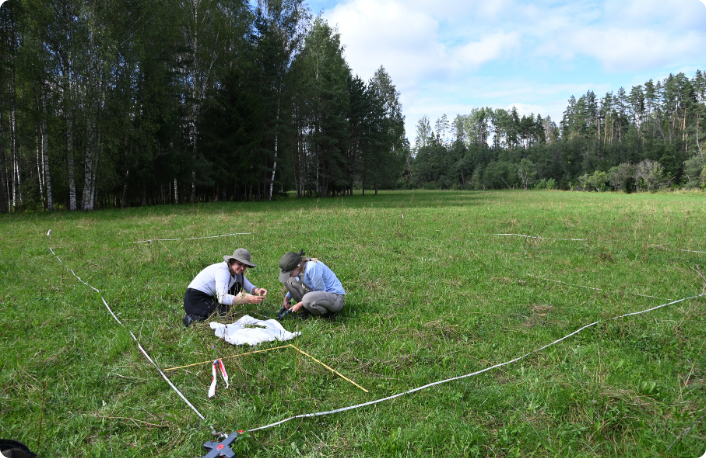
Setting up sample plots by University of Latvia experts in a semi-natural grassland. Photo: Solvita Rūsiņa.
Expected Results (2026–2027):
- Expert knowledge reports: Summaries of monitoring results and effectiveness assessments of restoration methods.
- Practical recommendations: Translating scientific findings into clear guidance for landowners and policymakers.
- Campaign support: Prepared draft reports (including those on vitamin E and socio-ecological aspects) to support the ecosystem services campaign led by the Latvian Fund for Nature.
By combining academic knowledge with field research, the University of Latvia helps build a sustainable foundation for the restoration and economically viable management of semi-natural grasslands in Latvia.
Institute for Environmental Solutions

The main task of the Institute for Environmental Solutions (IES) in the GrassLIFE2 project is to provide project farmers with plant seeds characteristic of Latvian semi-natural grasslands.
This is the first time in Latvia that semi-natural grassland restoration is being carried out on such a scale using scientifically cultivated seeds of local wild species.
- The Institute’s expertise ensures that the seeds are high-quality and genetically authentic to the region of Latvia.
- Scientists carry out a rigorous selection process, which includes identifying and mapping Latvia’s valuable grassland plants, identifying wild populations, and harvesting seeds from mother plants.
- In experimental seed gardens, specialists propagate only the highest quality and genetically appropriate plants.
- The geographical location of each mother plant is critical, as it determines the plant’s genotype. This is the only way to ensure that future generations can successfully establish and thrive in specific environmental conditions.
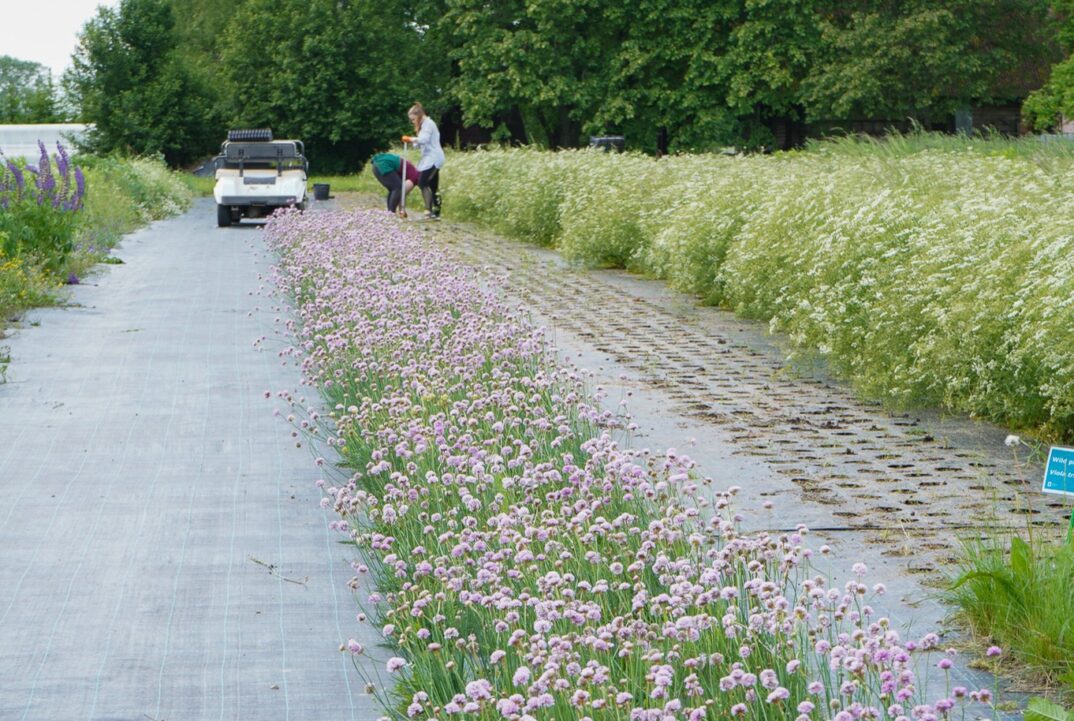
The Institute for Environmental Solutions cultivation area for semi-natural grassland plants. Photo: IES.
The work of IES researchers will provide seed material to restore 240 hectares of project areas. These seeds will go directly to farmers, who will transform scientific solutions into a blooming and diverse landscape.
Furthermore, the knowledge and experience gained by IES will be used in the long term to offer native wild meadow seed mixes to the general public, allowing anyone to become a creator of natural diversity in their own backyard landscape.
University of Tartu
The University of Tartu (UTARTU) serves as the main scientific partner in the GrassLIFE2 project, providing in-depth evaluation of ecosystem services in restored grasslands.
UTARTU leads research on the ecosystem services delivered by natural grasslands, with a particular focus on:
- pollination and pollinator diversity;
- carbon sequestration and storage;
- soil biodiversity, including mycorrhizal fungi and soil microbial communities;
- as well as forage quality.
As part of the project, UTARTU conducts monitoring and data analysis to assess the ecological impact of grassland restoration methods. The collected data are used to evaluate the effectiveness of restoration approaches, quantify improvements in ecosystem services provided by natural grasslands, and develop evidence-based recommendations for farmers.
UTARTU also plays an important role in testing the project’s restoration methods under Estonian conditions, helping to assess their applicability and transferability beyond Latvia.