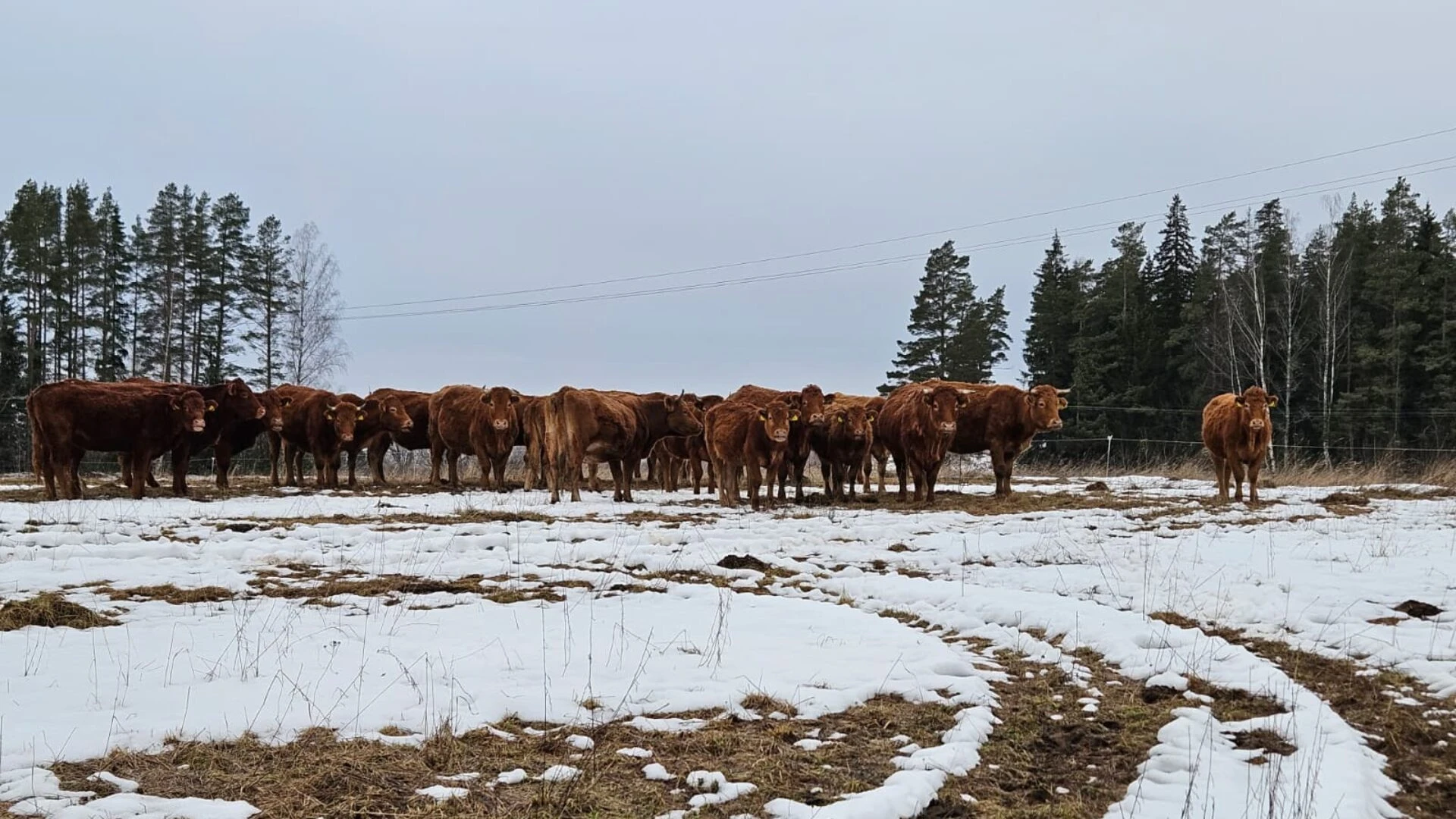
On March 3 of this year, partners of the GrassLIFE2 project went on an experience-sharing trip to Estonia to get a first-hand look at innovative and nature-friendly methods for winter grazing of cattle. Heartfelt thanks to Airi Kulvet (Puutsa Farm), as well as Harri and Eneken Lumiste (Pari Farm) for their warm welcome and valuable discussions at their farms!
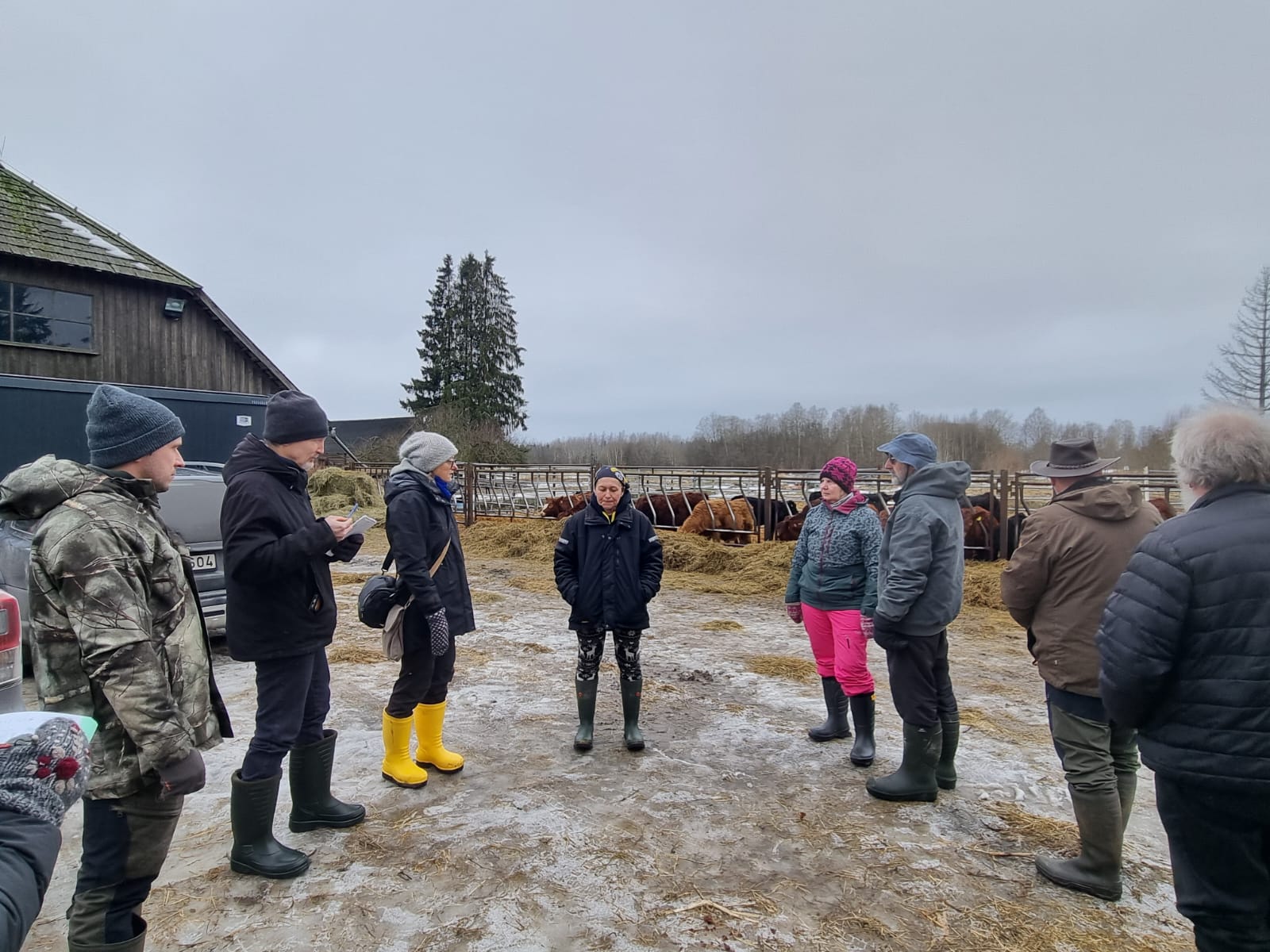
GrassLIFE2 partners visiting natural grassland management farms. Photo: Gunta Gavare.
Both farms successfully practice sustainable agricultural approaches that help maintain the quality of natural grasslands even during the cold season, while providing a significant boost to the farmers’ daily operations.
What is the hay bale unrolling method?
Both Pari Farm and Puutsa Farm employ the hay bale unrolling method during the winter period. Its core principle is feeding the herd by moving the paddocks every day and unrolling exactly as many hay bales in a new, previously ungrazed spot as the animals require for the day.
This approach offers several important nuances and advantages:
- Minimal hay residue: By unrolling a precise amount of hay daily, the uneaten grass is left in a very thin layer. The animals then use it for resting and bedding.
- Rapid decomposition: By the end of next year’s June, when the winter grazing cycle resumes in these areas, the hay residue and scattered manure have already completely decomposed.
- No expenses for manure removal: The owners emphasize that keeping natural fertilizer evenly distributed across the grassland is one of the greatest benefits of this method — in the spring, no time or financial resources are wasted on collecting and composting winter manure.
- Goodbye, mud! In areas without concreted feeding lots, late autumns and frost-free winters usually turn into endless mud. Unrolling hay bales and constantly rotating paddocks significantly reduces turf damage and the need to drive heavy tractor machinery onto the meadows.
An important prerequisite: To build the most resilient turf possible, grasslands planned for winter grazing are neither mown nor grazed during the preceding summer. To prevent over-fertilization of the grassland, the rotation is slow — such winter grazing takes place in the same grassland no more than once every five years.
Winter grazing without supplementary feeding
The managers of Pari Farm also practice another effective method in late autumn and early winter: winter grazing without supplementary feeding. The cattle graze in areas where the grass has been conserved and allowed to grow all summer. This grazing continues until a thick blanket of snow forms. In this case, too, the process relies on strict rotation: grazing takes place in small paddocks with boundaries shifted once a day, and the animals return to the same grassland no more than once every 3 to 4 years.
From natural grasslands to consumer recognition
During the experience-sharing visit, Airi Kulvet also showed her purebred and crossbred Wagyu cattle. The host introduced the operations of Liivimaa Lihaveis, a cooperative of Estonian grass-fed cattle breeders, and its brand — Livonian Beef. This collaboration is an excellent example of how biodiversity conservation goes hand in hand with business: high-quality beef from cattle raised on natural grasslands has been available to buyers in Latvia for more than five years, specifically at SKY and Stockmann supermarkets.
This experience shared by our Estonian colleagues proves once again that natural grassland management can be ecologically valuable, economically viable, and convenient for the farmer!